How to Calm a Puppy That Gets Too Excited Around Other Dogs
Barking, pulling, and frantic play do not always mean the same thing. Learn what to watch for and how to give your puppy a safer, easier next interaction.

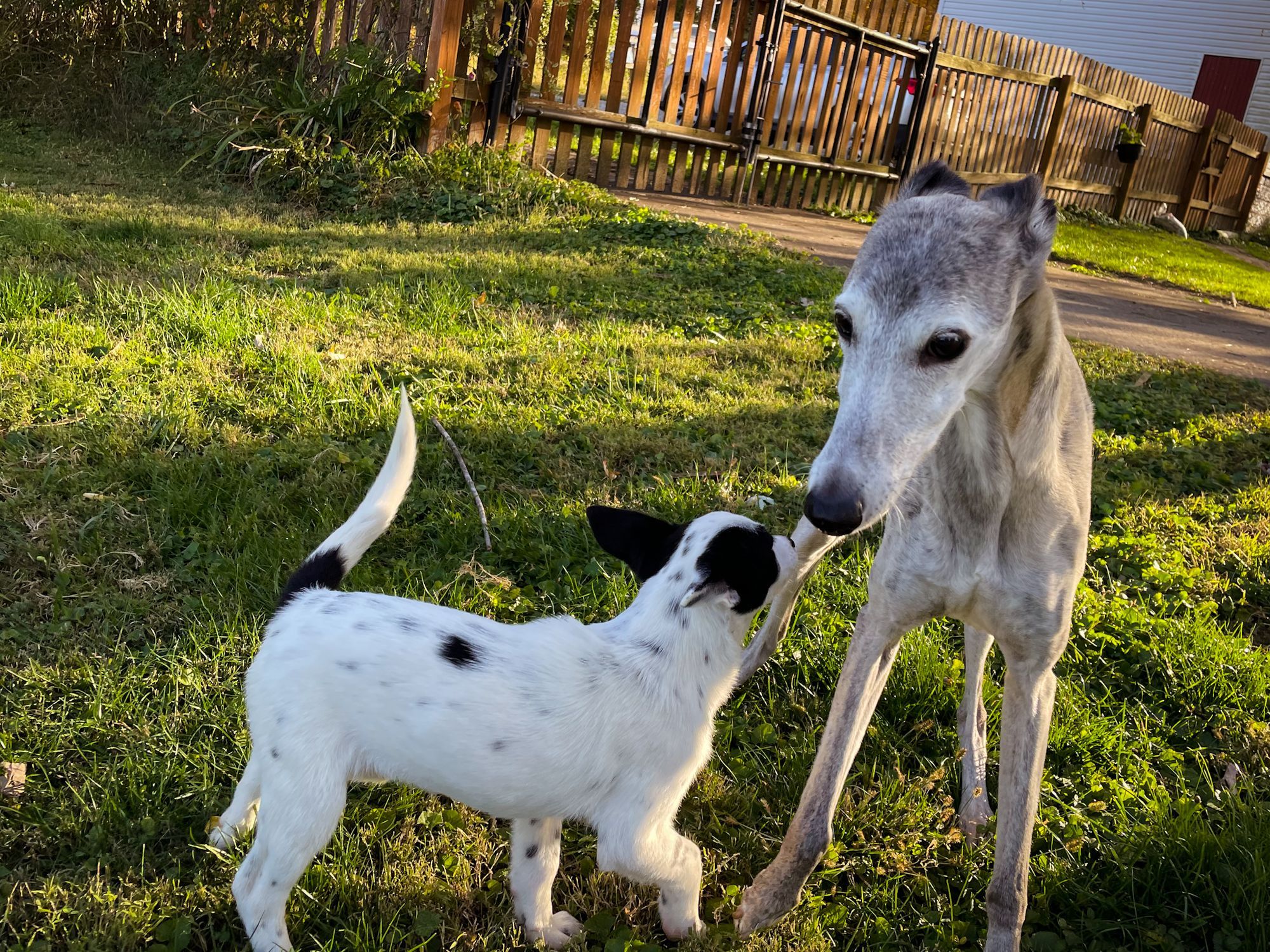
Quick answer: Why does my puppy get so excited around other dogs?
Unruly behavior around other dogs can come from social excitement. It can also reflect frustration, fear, conflict, reactivity, fatigue, or overstimulation. Barking or pulling by itself cannot tell you which one is happening.
First, look at what's happening. Does your puppy approach or try to get away? Does their body stay loose or become tense? Can they pause, disengage, and respond to you? What changes when you add distance? During play, do both dogs choose to continue? Notice how quickly your puppy recovers afterward.
A good first step is to create more space. Make sure you aren't forcing your puppy to greet people or other dogs, and end play before either dog becomes overwhelmed.
“Excited” can describe several different causes
My puppy Beatrix used to run, jump, bark, mouth, and scratch when she saw other dogs. Her behavior looked like obvious enthusiasm because she often wanted to play. The size of a puppy's reaction, though, does not explain what is driving it.
Similar outward behavior can appear in several situations. Puppies may also shift from one pattern to another during the same interaction.
Social enthusiasm
A socially excited puppy may move toward another dog with loose, wiggly movement. During play, you may see pauses, changes in activity, and opportunities for each dog to move away. The dogs may chase or wrestle, then separate briefly. If both choose to return, that voluntary re-engagement gives you more useful information than the intensity of any single moment.
Healthy play does not have to look gentle or perfectly equal. Play styles differ, and some dogs enjoy more physical play than others. What matters is the broader interaction, including whether both dogs remain willing participants.
Frustration
A puppy who wants access to another dog may bark, whine, jump, or pull harder when a leash, fence, or person blocks the way. The behavior may build as the puppy gets closer or expects a greeting. More distance, a change of direction, or a clearer routine may make it easier for the puppy to disengage.
Frustration can look dramatic. It does not prove that the puppy is friendly or that a greeting will be safe. The other dog may find a rushing, barking puppy difficult to tolerate.
Fear or conflict
A fearful or conflicted puppy may hang back, freeze, hide, lean away, or try to leave. Some puppies move forward and retreat repeatedly. Others bark, growl, or lunge when they cannot create the distance they need.
Avoidance matters, but no single posture or body part establishes how a dog feels. Look at what happened before the behavior, what the puppy does next, and whether added distance helps. Train Canine's guide to signs of stress in dogs can help you observe the larger pattern.
Reactivity
“Reactive” usually describes an intense response to a trigger. Around other dogs, that response may include barking, lunging, growling, spinning, or difficulty disengaging. The label does not tell you why the behavior is happening. Fear, frustration, previous experiences, the environment, and learning history may all be relevant.
One loud encounter is not enough to diagnose a behavior problem. Repeated patterns, the distance at which they begin, their intensity, and the puppy's recovery are more informative. If this pattern sounds familiar, read more about stress and environmental management for reactive dogs.
Overtired or overstimulated behavior
Puppy play can deteriorate as a puppy becomes tired or takes in more activity than they can manage. You may see increasingly frantic movement, harder grabbing, repeated pestering, or less response to interruptions. A puppy who played comfortably at the start may need help leaving before the interaction unravels.
Mixed patterns are common. A puppy can be socially interested and frustrated by restraint. The same puppy can become worried when another dog responds sharply. Use the categories below as observation guides, not diagnoses.
Body language consistent with social excitement
Look for a cluster of features such as:
- Loose, curved, or wiggly movement
- Voluntary approach without repeated pressure from the handler or the other dog
- Brief pauses or breaks in activity
- Enough responsiveness to disengage or move away
- Play that changes over time rather than one dog continually pursuing or pinning the other
- Both dogs choosing to re-engage after a pause
- A relatively quick return to ordinary behavior afterward
Context still matters. A wagging tail, play bow, or willingness to approach cannot establish friendliness by itself.
Body language consistent with frustration
Watch for patterns connected to blocked access:
- Barking, whining, jumping, or pulling that increases when the puppy cannot reach the other dog
- Escalation as the distance closes or when the puppy expects a greeting
- Difficulty orienting away while the other dog remains close
- Improvement when you create more space, move away, or remove the expectation of contact
- A history of greeting many dogs on leash, followed by bigger reactions when greetings are unavailable
This pattern may suggest frustration, but it does not make an immediate greeting a useful test. Create space and observe what changes.
Body language that suggests fear, conflict, or reactivity
Pay closer attention when you see a combination of:
- Repeated avoidance, hiding, freezing, or attempts to escape
- Tense movement or sudden stillness
- Approach followed by retreat
- Barking, growling, snapping, or lunging that escalates as the other dog approaches
- Pursuit or pressure that continues after one dog tries to leave
- Little ability to pause or disengage
- Continued scanning, vocalizing, avoidance, or agitation after the interaction ends
- A pattern that begins at greater distances or becomes more intense over time
None of these observations proves that a puppy is fearful or aggressive. They are reasons to add distance and take the pattern seriously.
Stop and get help when…
End the interaction when there is an immediate risk of injury or when either dog cannot get relief. Get qualified help if you see:
- A bite or attempted bite
- Injury to either dog or a person
- Panic or extreme fear
- Repeated pinning, cornering, or pursuit when the other dog tries to escape
- A history of escalating incidents
- A size difference or other situation that makes separation unsafe
- Behavior that you cannot safely interrupt or move away from
If dogs are fighting, keep yourself and others safe first! Ask a qualified professional for case-specific prevention and handling guidance after the immediate danger has passed.
What to watch before, during, and after an interaction
Before
Notice the starting conditions:
- How far apart are the dogs when your puppy begins to get excited?
- Is the setting quiet or crowded?
- Is either dog restricted by a leash, gate, corner, or small space?
- Has your puppy had enough rest?
- Was your puppy already aroused by a walk, visitors, training, or earlier play?
- Does either dog have a genuine choice to approach or leave?
- Is this a familiar, compatible dog or an unknown dog?
A puppy who manages a familiar dog in a quiet yard may struggle with an unfamiliar dog on a narrow sidewalk. Record the setting instead of treating the two encounters as equivalent.
During
Watch how the interaction develops. Loose movement and changing activities are what we're after; tension, stillness, relentless pursuit, or an inability to separate the pups means it's time to stop.
If the dogs are playing, look for pauses and responses to each other's movement. The pups' roles may change during play, but healthy play does not have to follow a perfect back-and-forth pattern. A useful check is to create a brief, calm pause without restraining one dog close to the other. If both dogs choose to return with comfortable movement, the play may continue. If one dog leaves, hides, stays close to a person, or avoids returning, respect that choice.
After
Observe what recovery looks like:
- Can your puppy move away without repeatedly trying to return?
- Can they respond to an easy, familiar cue?
- Can they eat comfortably if food is offered?
- Do they settle after a quiet break?
- Do they continue scanning, barking, pulling, or trying to hide?
- Does the behavior remain elevated during the rest of the walk or at home?
Taking food is one piece of information. It does not prove that a puppy is comfortable. A puppy who cannot eat may be too aroused or distressed for that setup, while a puppy who eats may still need more space.
What to do when your puppy becomes overwhelmed
When your puppy's behavior starts to build, use a conservative plan.
- Increase distance or end the interaction. Move away while you still can. Cross the street, turn down another path, call your puppy out of play, or use a visual barrier. Avoid waiting for a larger reaction before responding.
- Allow a quiet recovery period. Give your puppy time away from the other dog. Do not immediately return to the same distance to see whether they are “better now.”
- Skip punishment and forced proximity. Leash corrections, scolding, forced greetings, and repeated exposure intended to “get them used to it” may add distress or conflict. Current guidance from the American Veterinary Society of Animal Behavior recommends reward-based training and environmental management rather than aversive methods.
- Use food or movement only when your puppy can engage comfortably. A treat can reinforce a voluntary check-in or help you move away together. It should not be used to lure a worried puppy closer or to keep them in an interaction that is deteriorating.
- Make the next setup easier. Add more space, choose a quieter location, keep the session shorter, and work with a familiar dog whose play style suits your puppy.
Be aware when doing on-leash greetings
A leash helps keep a puppy safe, but it also limits movement. A puppy may be unable to approach in an arc, pause at a comfortable distance, or leave when they have had enough. Tension in the leash can further restrict the interaction.
Some puppies can greet safely on leash in carefully chosen situations. Your puppy can also learn to pass dogs without greeting them. Automatic greetings can build an expectation of access, which may make frustration harder when a greeting is unavailable. Close greetings also reduce your room to respond if either dog becomes uncomfortable.
Choose your pup's greetings deliberately. Give both dogs space, keep the interaction brief, and avoid putting pressure on either dog to continue. Skip the greeting when the location is tight, either dog is pulling or tense, or you do not know whether the dogs are compatible.
Practice useful skills when your puppy is calm
Skills give you ways to communicate and move through an environment together. Teach them at home or in another easy setting before asking for them around dogs.
Name response or orientation
Reward your puppy for turning toward you when they hear their name or notice you. Later, a voluntary glance back can help you recognize that your puppy still has enough capacity to engage.
Hand target
Teach your puppy to touch their nose to your hand. A hand target can help with a small change of position or start movement away from a distraction.
Recall or moving away together
Practice a cheerful recall in a safe, low-distraction space. You can also teach a simple phrase that means you will turn and move away together. Reward the puppy after they come with you.
Brief settle or pause
Teach a short pause on a mat or beside you when nothing difficult is happening. Around other dogs, recovery may require leaving the area rather than asking the puppy to hold still nearby.
These skills are useful only when the puppy can perform them comfortably. A response to a cue is not proof that the puppy feels safe. Do not use obedience to keep a puppy in an interaction that has become unsafe.
How to make the next interaction easier
Change one or two conditions before asking your puppy to try again:
- Begin farther away.
- Keep the session shorter.
- Work around fewer dogs.
- Choose calm, socially compatible play partners.
- Offer breaks before play deteriorates.
- Make sure the puppy has a clear exit route.
- Reward voluntary check-ins and decisions to disengage.
- Track the location, distance, dogs involved, activity, and recovery afterward.
There is no universal puppy play-session length. Some puppies need a break after a few minutes. Others can play longer while remaining responsive and able to pause. Let the individual puppy's behavior and recovery guide the session.
Early socialization should include safe, positive experiences without forcing a puppy to interact. Carefully run puppy classes and planned time with suitable dogs can help. A dog park or uncontrolled group is not the only way to socialize a puppy. The AVSAB puppy socialization position statement recommends positive exposure while also considering vaccination and disease risk with a veterinarian.
When to seek qualified help
Always ask for professional help when there has been biting, attempted biting, or injury. Intense fear, repeated escalation, slow recovery, or an interaction you cannot manage safely also is something you should seek help with. A qualified professional can review the history and observe the pattern and help you design a plan to change your puppy's behavior.
Start with your veterinarian if the behavior appeared suddenly, changed sharply, or could involve pain or another medical factor. Veterinary behavior guidance recognizes that medical conditions can contribute to behavior changes and that aggression requires careful attention to safety. A veterinarian can evaluate health concerns and refer you when needed.
For situations involving persistent fear, reactivity, or aggression, look for a credentialed reward-based trainer, behavior consultant, or veterinary behaviorist who can explain their methods clearly. Avoid anyone who guarantees a result or relies on pain, fear, dominance, or forced exposure. AVSAB provides guidance on selecting a behavior consultant.
Frequently asked questions
Should I let my puppy greet every dog on leash?
No, there is no need and in most cases it's best not to. Your puppy can learn to pass dogs without greeting them. Choose any on-leash greeting carefully, with enough room for both dogs and no pressure to continue. Skip it when either dog is pulling, tense, overwhelmed, or unable to move away comfortably.
Why does my puppy bark and pull toward other dogs?
Your puppy may want to approach and feel frustrated by the leash. Barking and pulling can also occur with fear, conflict, or reactivity. Notice what changes with distance and whether the puppy is trying to approach, avoid, or do both.
How long should puppy play sessions last?
There is no universal time limit. End or pause the session while both dogs are still coping well. Watch for deteriorating play, frantic movement, harder grabbing, repeated pursuit, reduced responsiveness, or difficulty recovering. Shorter sessions with early breaks are often easier to evaluate.
What does healthy puppy play look like?
Healthy play varies. Look for loose movement, pauses, opportunities to leave, responses to the other dog's signals, and voluntary re-engagement. Chasing, wrestling, growling, and mouthing can occur during play, so judge the interaction by the whole pattern. If one dog repeatedly tries to escape and the other does not let up, intervene.
When should I stop a puppy play session?
Stop when either dog is trying to leave, hide, or get relief and cannot. End the session if the play becomes tense or relentless, one dog repeatedly pins or pursues the other, the dogs do not respond to a calm interruption, or there is a bite, attempted bite, panic, or injury.
Can treats make my puppy calmer around other dogs?
Treats can reinforce check-ins, orientation, and moving away with you. They can also support carefully planned behavior work. Be careful not to use food to lure a worried puppy closer to what is scaring him. Also be aware that treats can trigger snips and snaps (or even fights) because of resource guarding between dogs.
When should I ask a trainer or behavior professional for help?
Seek help after biting, attempted biting, injury, intense fear, repeated escalation, or slow recovery. Get support sooner if a size difference or handling problem makes interactions unsafe. Contact your veterinarian when behavior changes suddenly or pain or illness may be involved.
Choose an easier next step
You do not need to test your puppy with another close greeting. Start with space, watch how the pattern changes, and plan the next interaction around what your puppy can manage.
Continue with Train Canine's dog-training and behavior resources or learn how to compare stress signals with relaxed dog body language.